

Description
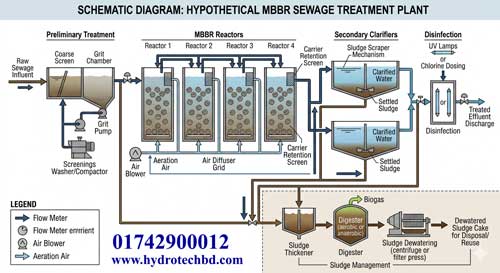
A Moving Bed Biofilm Reactor (MBBR) sewage treatment plant uses a specialized biological process where microorganisms grow on small, floating plastic carriers. These carriers move freely within an aeration tank, providing a high surface area for bacteria to break down organic waste.
Core Components of an MBBR System
An efficient MBBR-based Sewage Treatment Plant (STP) typically follows these stages:
- Preliminary Treatment: Screens remove large debris like plastics and rags, while a grit chamber settles sand and stones.
- Equalization Tank: Collects raw sewage to balance flow and concentration, ensuring a steady feed into the biological reactors.
- Anoxic Tank (Optional): Used specifically for denitrification (removing nitrogen) if required by local environmental standards.
- MBBR Aeration Tank: The “heart” of the system. It contains:
- Bio-media: Small plastic carriers (filling 25–70% of the tank volume) where the biofilm grows.
- Aeration Grid: Diffusers at the bottom that provide oxygen and keep the media in constant motion.
- Retention Sieve: A mesh screen that prevents the plastic media from leaving the tank with the water.
- Secondary Clarifier: A settling tank where remaining biological solids (sludge) separate from the treated water.
- Tertiary Treatment: Final filtration (e.g., pressure sand filters) and disinfection (e.g., chlorination) to make the water safe for reuse or discharge.
Why Choose MBBR?
- Compact Footprint: Requires less space than traditional activated sludge systems.
- Low Maintenance: No need for “return activated sludge” (RAS) pumping, as the biomass stays attached to the carriers.
- Scalability: Capacity can be increased by simply adding more media to existing tanks.
Would you like to see a specific flow calculation for a particular daily sewage volume (e.g., 100 KLD)?
Related products
-
Quick View
- Sale!
- Accessories, Commercial Reverse Osmosis, DM/Battery Water Plant, Iron Removal Plant (IRP), Reverse Osmosis (RO), Sewage Treatment Plant (STP), SEWAGE TREATMENT PLANT(STP), Virus and Bacteria Removal Plant (UV), Water Treatment Plant (WTP)
Water Treatment Media Price in Bangladesh.
- Original price was: ৳ 100.00.৳ 90.00Current price is: ৳ 90.00.
- Add to cart
-
Quick View
-
Quick View


Reviews
There are no reviews yet.